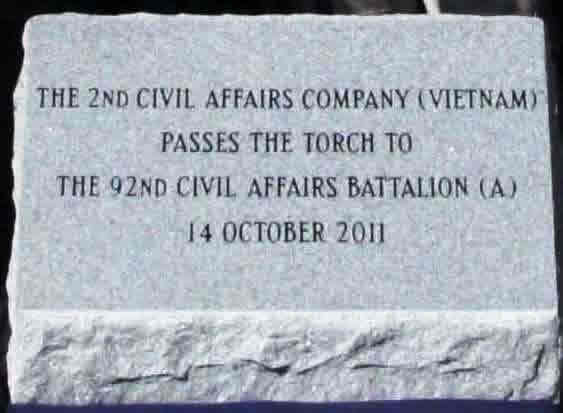
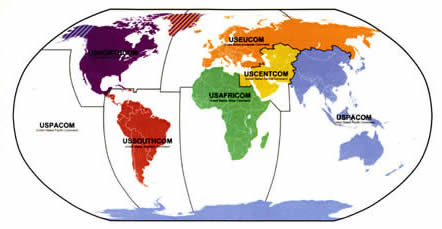
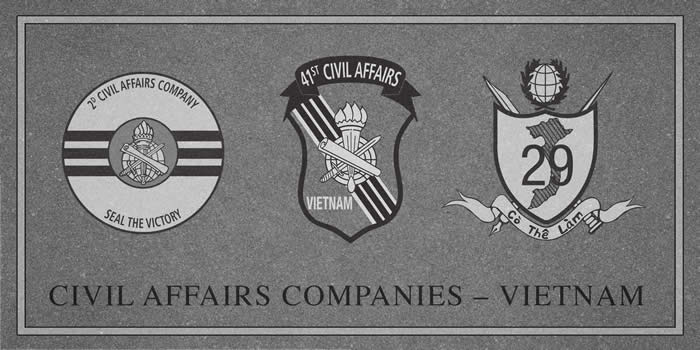
Revised: 14 Oct 2011 - the 92nd CA Bn.
x
The 2nd Civil Affairs Company was reactivated on 23 May 1966 at Fort Gordon in Augusta, Georgia. The 2nd Civil Affairs (2nd CA) was assigned to the 95th Civil Affairs Group also at Fort Gordon which then included HHC, 95th CA and the 42nd Civil Affairs Company. |
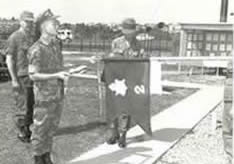
Presentation of the RVN Civil Action Medal |
|
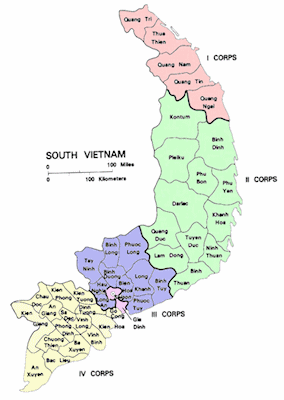
In the fall of 1966, the 2nd CA deployed to Vietnam where it was assigned to Headquarters, Second Field Force - Vietnam (II-FFV). The II-FFV was the U.S. Army corps-level headquarters that controlled the operations of U.S. Army divisions and separate brigades in the III Corps Tactical Zone (III-CTZ) and the IV Corps Tactical Zone (IV-CTZ) of the Republic of Viet Nam (RVN).
The 2nd CA Headquarters and Base Camp was located at the Plantation Compound (click the Link to the Map below and then go to YT 046 104) along with the Headquarters of II-FFV. The Plantation was located on the east side of Highway 1A (later redesignated as Highway # 316) and north of the road junction with Highway QL 15 (the Bien Hoa - Long Thanh - Vung Tau road). The Plantation was east of Bien Hoa and east south east of the runways at Bien Hoa Air Force Base and north of the Long Binh Logistics Base.
Map - 2nd Civil Affairs HQ at Plantation Base, Long Binh - 1971
"The Mission" of the 2nd Civil Affairs Company was “To Seal the Victory” in the secure areas of Vietnam by “Winning the Hearts and Minds" of the Vietnamese people. To help the Vietnamese civilian population improve the quality of their lives and to try to persuade the Vietnamese to support their nationally elected government - the Government of Vietnam (GVN) in Saigon.
Civil Affairs Soldiers were once officially described as: 'specially trained soldiers' who were 'culturally oriented and linguistically capable' to provide 'functional expertise about civilians' and civil operations to the 'U.S. commanders of direct action missions or unconventional warfare operations' as well as to assist the GVN internal defense operations Woh !, I am glad someone else could write this, I was there in '66 and '67 and I personally could not have written this 'word salad'.
CIVIC ACTION PROJECTS NEVER KILLED ANYONE !
Unit Organization
The Table of Organization & Equipment (TOE 41-500-D) for the 2nd Civil Affairs changed several times - officially and provisionally (Prov) in Vietnam. The original organizational concept was similar to the U.S. Army Special Forces unit configurations. There were: "C" Detachments (CA Group Headquarters - 95th Civil Affairs Group), "B" Detachments (CA Company Headquarters - 2nd CA), "AA Platoons" (Team AA - Platoon Headquarters) and "A Teams" (special function teams within a Company).
The original configuration of the 2nd CA at Fort Gordon consisted of a Company Headquarters with a Switchboard Operations Team, a Mess Team, an Automotive Maintenance Team plus three Team AA Platoon Headquarters and functional teams: one Public Safety Team, one Civilian Supply Team, two Public Welfare Teams, at least one Food & Agriculture Team and at least one Public Health Team. Other recent roster data suggests that other teams were authorized but never activated for Civilian Supply & Transport, for Public Finance and for Public Works & Utilities as well as possible second teams for Public Health and for Food & Agriculture. Other teams may have been authorized but were never staffed and are now forgotten.
The Company Colors
The first enlisted men assigned to the unit were the Supply Sergeant and the Supply Clerk. A very proper assignment by the U.S. Army. In late May and early June, they requisitioned every item authorized in the TO&E including the 2nd CA Guidon. Ultimately, the brand this new Guidon was received in September 1966.
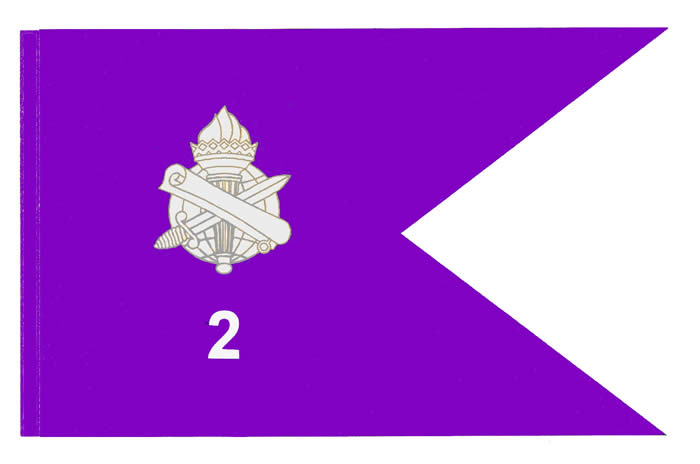
However, during the early summer of 1966, the 2nd CA Company Headquarters received an unanticipated phone call from Fort Bragg indicating that "the original" 2nd Civil Affairs Guidon was then at Fort Bragg, NC. So the 2nd CA's Commanding Officer, the First Sergeant and the Supply Sergeant traveled to Fort Bragg where they were officially presented with the original 2nd Civil Affairs Guidon from our former senior unit - the 6th Special Forces Group (Airborne). Ultimately, the 2nd CA would have two Guidon Flags - new guidon on requisition through supply channels and the original 2nd CA Guidon from Fort Bragg.
Standing Up the Unit
A few early arriving Officers, NCOs and Enlisted Men reported for duty in late May 1966 just before Memorial Day while many others arrived in the first week of June 1966. Soon thereafter, most of the Officers attended the U.S. Army Civil Affairs School at Fort Gordon while the Enlisted Members had orientation and training in the company area. Vietnamese language classes were taught at least four nights per week. The months of August, September and part of October were spent on Company Field Training and Team Building Exercises. The original TO&E had 22 Officers and 70 Enlisted Men.
The 2nd CA's original TO&E was first modified In June 1966 when the Automotive Maintenance Team (Team DA) was told to 'turn-in' their brand new tool kits and wrenches before the team was ever fully staffed. The loss of the automotive maintenance tools would plague the unit for many years. In early October 1966, the Mess Detachment (Team CA) was told they would not be deploying with the unit and that they would be disbanded after the Main Body departed for Vietnam – one cook volunteered and did deployed with the 2nd CA when they changed his MOS. The Public Safety Team (Team MC) may have also been disbanded at this time because the Public Safety Team Leader became the Executive Officer (XO) and the original Executive Officer became the new Operations Officer (S-3). The authorized number of platoons (Team AA - Platoon Headquarters) may have increased from the original three to at least five. Other teams were certainly contemplated but never staffed by the Department of the Army (DOA). The names of the other officers and their branches (Engineers, Finance Corps as well as a second Medical Doctor) were known but these officers never reported for duty. Hopefully, the Company Commander was aware of the DOA changes but he certainly did not communicate these changes to the junior members of his staff.
In May of 1966, the 2nd CA Supply Section had requisitioned only thirteen Jeeps (M-151s) along with their companion 1/4 ton Trailers (M416s), seven 3/4 ton Trucks (M-37s) and three 2-1/2 ton trucks (M-35s). During the standing up and summer field training exercises, the 2nd CA had only one very well used M-151 Jeep, plus three or four of the M-37 (3/4 ton) trucks which may have been resurrected from salvage disposal and our three once brand new M-35 (2-1/2 ton) trucks. The night before the Equipment Convoy was scheduled to leave for the port of embarkation, the Fort Gordon Post levied the missing vehicles from other units on the post. Although Radios were requisitioned stateside, they were never issued and not one vehicle had a vehicle mounted AN-VRC53 radio (when removed from the mount, it was called an AN-PRC25). The majority of the additional vehicles were received between Midnight and 0230 Hours on the same day that the 2nd CA's Equipment Convoy would Motor March to the port of embarkation. The Convoy departed 'on time' at 0600 Hours with at least 26 Jeeps (M151s), 13 of the ¾ ton Trucks (M-37s) and our original three once brand new 2-1/2 ton Trucks (M-35s). SNAFU and FUBAR.
None-the-less, the first elements of the Company began deployment to Vietnam in October and November of 1966. The authorized size of the unit was certainly increased in October 1966 when additional NCOs and Enlisted Men arrived just before the Main Body departed. Additional 'combat gear and weapons' were being requisitioned and issued while all of the other equipment was being packed and crated for shipment overseas.
Some additional NCO's and Enlisted Men were assigned to the unit in late October but were not Civil Affairs trained. These late arriving members were called the “Second Increment”. Simultaneously, two 1st Lieutenants became non-deployable because they were then “90 Days Losses”. One Lieutenant became the Officer-In-Charge (OIC) of training of the “Second Increment”.
The Deployment to Vietnam
The Equipment Group was the first element to depart from Fort Gordon at Augusta, Georgia. During the Summer of 1966, the Company had just one Jeep (M-151), just three or four 3/4 Tons Trucks (M-37) and three brand new 2-1/2 Ton Trucks (M-35 multi-fuel). The evening before and in the dark early hours of the morning before the Equipment Group was to depart for the port of embarkation, the Fort Gordon Supply Group levied the missing vehicles and equipment from other units on base. The Company departed with at least 26 Jeeps, 13 M-37s - 3/4 Ton Trucks and 3 M-35s - 2-1/2 Ton Trucks but without certain authorized TO&E equipment (AN/VRC 53 Radios, M-79 Grenade Launchers and others miscellaneous tools). The Company’s Equipment was convoyed to Savannah, Georgia where the vehicles and ConEx Containers (12 ±) were loaded onto the USNS LT. George W.G. Boyce (T-AK-251) (a Military Sea Transport Service ship with a DOD civilian crew - retired Navy). The ship departed on or after October 15, 1966 sailing first to Norfolk, VA to pick up additional deck cargo, thence via the Mediterranean Sea and through the Suez Canal, stopping at the Port of Aden in Yemen for refueling, then steaming to Nha Trang to offload deck cargo and the ship finally arrived at Saigon at the Cholon Docks, in the old French Pier area, in the first week of December 1966 and before the Main Body arrived.
The Vehicle unloading started around 1700 Hours and it was completed by 0400 Hours on a very hot and very humid night that made life in the 'Cargo Hole' of the equipment ship a 'once in a lifetime experience' that will never be forgotten. The next morning, our vehicles were driven to the Plantation Base Camp by members of the 53rd Signal Battalion because our Main Body was still in-transit to Vietnam. The 'organized convoy' soon became separated by the civilian traffic in downtown Saigon and the Saigon Police Traffic Directors (White Mice) with their always confusing hand signals which no one ever understood, much less obeyed. The Convoy's Road March can best described as a 'pedal to the metal' sprint up Highway 1A to the Plantation. Although we had proceeded with all possible due haste, our ARVN allies (Army Republic of Viet Nam) with their older gasoline powered 'Deuce 'n Hafs' always sped past our brand new multi-fuel diesel counterparts. The ARVN drivers had disabled the governors on their gasoline engines. Someone always 'Brings up the Rear' looking for disabled vehicles and road wrecks but all of our vehicles and equipment safely arrived at the Plantation despite their 'wild ride'.
The Main Body departed Fort Gordon on 8 Nov 1966 and they flew from Augusta, Georgia to San Francisco and thence by vehicle over the Bay Bridge to the Oakland Army Base and onto the USNS General W.S. Gordon (T-AP-117). The troop ship departed Oakland on 9 Nov 1966 and once the ship cleared "the 12 Mile Limit", the U.S. Territorial Waters Claim, your tour time commenced on 9 Nov 1666. The ship then sailed across the Pacific, with a unplanned detour to Okinawa for a medical evacuation and then continued on with planned stops at Da Nang, Qui Nhon, Cam Ranh Bay before reaching Vung Tau on 6 Dec 1966. Everyone really appreciated being off the ship and onto dry land after 28 days on the high seas. The Main Body was air-lifted from Vung Tau to Bien Hoa Airfield by USAF C-123s. Between the C-123's Rear Ramp and the first Jeep, the Operations Officer (S-3) requested beer and booze refreshments for everyone because the trip across the Pacific Ocean had been very long and the "boat was dry". The Main Body had finally arrived "in-country" was at the Plantation Base Camp on 6 Dec 1966 along with the 2nd CA's original Guidon.
The Advance Party - the last to leave and the first to arrive - departed Georgia on or after 18 Nov 1966, flying from Augusta to Atlanta, through Dallas, and unto San Francisco via commercial airliner. The Advance Party transferred to chartered Boeing 707 (a Piedmont-Northwest Orient Airlines 707) at Travis AFB near Stockton, CA which flew to Seattle, then to Tokyo (the Japanese Government did not allow the Advance Party to get off the plane because they did not want their Sacred Soil stained by American Soldiers going to Vietnam) thence to Tan Son Nhut Airport at Saigon arriving after midnight on 19 Nov 1966. The Advance Party stayed at the famous (or infamous) 'tent-city' called Camp Alpha on a hot, steamy, smelly night. Welcome to Vietnam ! The travel time was estimated at 27 Hours (±). The 'Quiet of the First Night' was shattered when a "VC Rat" ran down the top of the mosquito netting - a branch of the Ho Chi Minh Trail - and then "pissed upon the occupant" of the upper bunk rack at the Five Star Hotel named 'Camp Alpha'. The first morning in Vietnam 'started super early' with an unanticipated 'urinary attack' which was never discussed in stateside training. (added Dec 2022).
Getting Started and the First Year
The Advance Party moved from Camp Alpha to the Plantation Base Camp in Long Binh where it was hosted and assisted by the 53rd Signal Battalion before the arrival of our Main Body and the building of our base camp facilities. Our base camp neighbor, the 9th Transportation Company (Airborne) shared their mess facilities for more than five years with the 2nd CA Headquarters Detachment as well as with numerous unanticipated visiting members of our platoons. Thank You, to all.
The Mailing Address was APO SF 96266 and the unit identification code was WA8GAA. The original Telephone Number was Hurricane 145 which was replaced by Plantation 5355 and 5716 in the later years. The establishment of a Radio Net was avoided in 1966-1967 but an unauthorized Radio Call Sign was "Plantation 54".
When the Advance Party arrived, the 2nd CA Company Commander "Reported To" the Commanding General of II-FFV (the CG was a 3-Star LT GEN) and the C.O. of the 2nd CA was told (VOCG - Verbal Orders of the Commanding General) that the unit would not function as organized and trained in the U.S.A. to work on an 'area basis'. Instead, the 2nd CA Platoons would be attached to the headquarters of the maneuver brigades in the III and IV Corps Tactical Zones (III-CTZ and IV-CTZ) of Vietnam which were in the Second Field Force Vietnam (II-FFV) Area of Operations (AO).
From the original stateside configuration of three platoons and several specialists teams, the 2nd CA was initially re-organized into 7 platoons and then over the next two weeks, it was expanded again to 11 platoons, then to 13 platoons - all of which were deployed by 15 Dec 1966. The 14th Platoon was formed on 27 Jan 1967 and attached to Australian Task Force, Vietnam.
Included in this USARV locally directed reorganization were the three Displaced Persons Teams (Team VA - # 2, 7, 14) from the 41st Civil Affairs Company who were initially "fully attached" to the 2nd CA in December 1966 but it took until the end of July 1967 for the U.S. Army's official paperwork to catch up and then these Teams were finally "officially transferred into" the 2nd CA. In the summer of 1967, some new arriving 2nd CA Lieutenants who were CA School Trained were soon transferred to the 41st CA. While most of the original 41st CA Men continued to work with 1st Infantry Division although officers and men from both units were intermixed to share and to gain experience. The six Officers and four Enlisted Men from the 41st CA were welcomed and well respected as seasoned veterans with at least three and up to twelve months of successful and pioneering CA field operations with Revolutionary Task Force sponsored by the U.S. 1st Infantry Division.
The Second Increment which was left behind at Fort Gordon, Georgia so they could be trained as Medics and Linguists finally departed for RVN on or after February 16, 1967. They sailed across the broad Pacific aboard the USNS General William Weigle (T-AP-119) and came ashore at Vung Tau on 22 March 1967 after 22 days on the high seas. Our brothers were welcomed Our first family was complete and finally together again.
The brand new 2nd CA Guidon flag which had been ordered through the normal supply channels finally arrived at Fort Gordon sometime in October 1966. It was intentionally left behind in the care of the Second Increment at Fort Gordon. This was a "Team Building Decision" so that the Members of the Second Increment could identify with and feel part of the unit that they would later join in the fields of Vietnam. The Second Increment carried their 2nd CA Guidon flag ashore with them on March 22, 1967.
When the fifty-two Men, three NCOs, and one Officer finally rejoined the Company, each platoon was selectively augmented and rounded out so that every platoon had at least one NCO, one Medic, one Admin Specialist and a Linguist - an American Soldier who spoke Vietnamese, a brother who we could really trust as our interpreter.
Changes during the First Year
On 13 April 1967, USARV authorized every unit then in-country two additional TO&E slots to support the U.S. Army's TAERS program (The Army's Equipment Reporting System) with the addition of slots for a Maintenance Records Clerk and for a Repair Parts Clerk but they did not increase any unit's TO&E strength. At this point in time, the 2nd CA's did not have an authorized Maintenance Team much less any slots for Vehicle Mechanics or even a Maintenance Team Leader. None-the-less, the Company was officially commended on 27 July 1967 in the Inspector General's (IG) Report for our new Vehicle Maintenance Building with our unique 'drive-over' work pit and for our successful vehicle maintenance program with "borrowed" tools.
The Second Increment staffing authorization also included an additional twenty-six officers who began to arrive on or after 1 July 1967 either in small groups or individually. The Company's Table of Organization & Equipment (TO&E) varied over the years (MTOE) but the typical "Morning Report" strength had 48 Officers and 124 Enlisted Men.
During the summer of 1967, while our first year in-country (1966-1967) was coming to an end, an additional eight platoons (15th - 22nd Platoons) were created with arrival of the new officers and the splitting up of the now seasoned 2nd CA personnel. By the end of August 1967, twenty-two AA Platoons had been staffed and deployed. We were finally at full strength.
Between the 17th and 25th of November 1967, the Company staffed seven "CA Teams" (Nos. 31-37) to work with the MACV's Province Senior Advisors (PSA). Each "CA Team" was staffed with one officer and two enlisted men. The CA Teams may have been created and functioned as transition cadre in anticipation of the reassignment of the platoons from the Brigades to the MACV Advisory Teams.
The "Periodic Civil Affairs Report - 1 Feb 68 to 29 Feb 68" from the Headquarters, 2nd Civil Affairs Company refers to "26 AA Platoons/Teams" in the field during that month.
Esprit-de-corps ( added - Jan 2010 )
Soon after our first year "in-country" ended on 6 Dec 1967, the Company reported in January 1968 that 58 Men had extended their foreign service tours and this represented almost 40% of the 146 original members of the Main Body and Second Increment. Truly amazing !
So "What did we really do ?" when we were attached to the Brigades ?
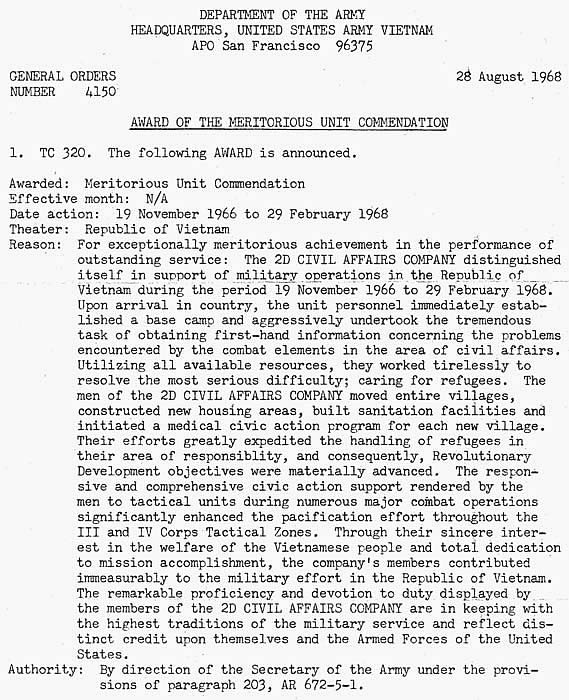
The Accomplishments
First and most important, the Mission of the Company would not have been accomplished without the outstanding work of the Enlisted Members of the Platoons and the Teams. The NCOs, the Medics, the Linguists, the Drivers, the Mechanics and the Clerks of the Platoons and Teams always did more than one job and could be counted on to meet or exceed expectations. Their great work must be acknowledged. "Thank You" to all for your dedication and doing a great job.
Participation in Tactical Operations ( added - Feb 2010 )
In the commendation above, USARV said " the support rendered by the men to tactical units during numerous major combat operations"...
Please take a minute and think about - what you did, where you were and just " How many 'non-combat' units ever lived, worked, ate and slept with the U.S. Infantry battalions 'in the field' for weeks at a time ? ".
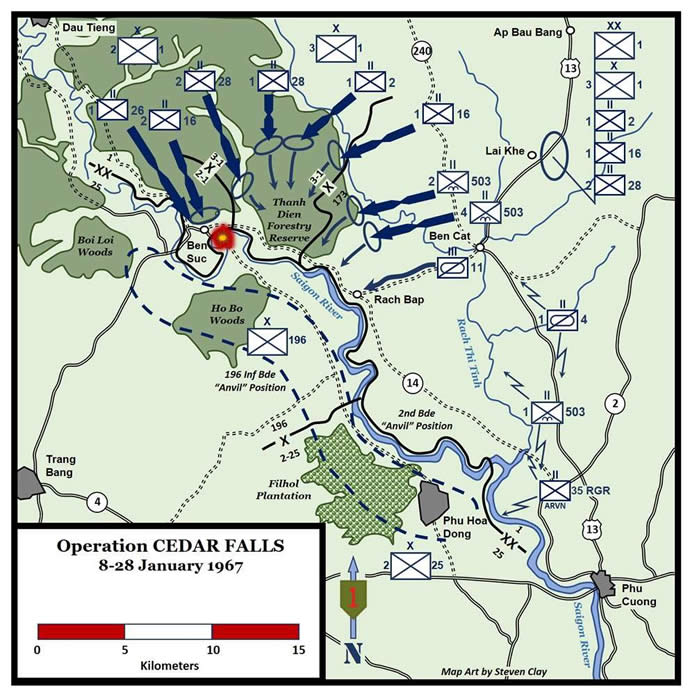
In early 1967, II-FFV conducted multi-divisional operations against VC Main Force units and NVA Regiments in the "Iron Triangle" - an area which the French never entered when it was part of War Zone "C". Multiple 2nd CA Platoons were there and they assisted with the movement of 'Refugees' (GVN supporter) and 'Evacuees' (hostage VC families) as well as with the collecting, warehousing and redistribution of food stocks captured during major operations. Operation Cedar Falls was started in January 6, 1967 and it was conducted by the U.S. 1st and 25th Infantry Divisions supported by the 11th Armored Cavalry along with augmentation from the 173rd Airborne which lasted for 20 days.
Operation Junction City was started on February 22, 1967 with an Parachute Assault Landing by reinforced battalion from the 173rd Airborne Brigade to secure the Landing Zone (LZ) for helicopter insertion of the other 173rd battalions who acted as the operation's blocking force. Ultimately, a total of 22 U.S. maneuver battalions from the U.S. 1st, 4th and 25th Infantry Divisions along with augmentation from the 196th Light Infantry Brigade as well as from the 11th Armored Cavalry with their armored cavalry squadrons (battalion size units) - all of whom participated in Operation Junction City which lasted for 83 days. And ten of the then fourteen 2nd CA platoons were there too.
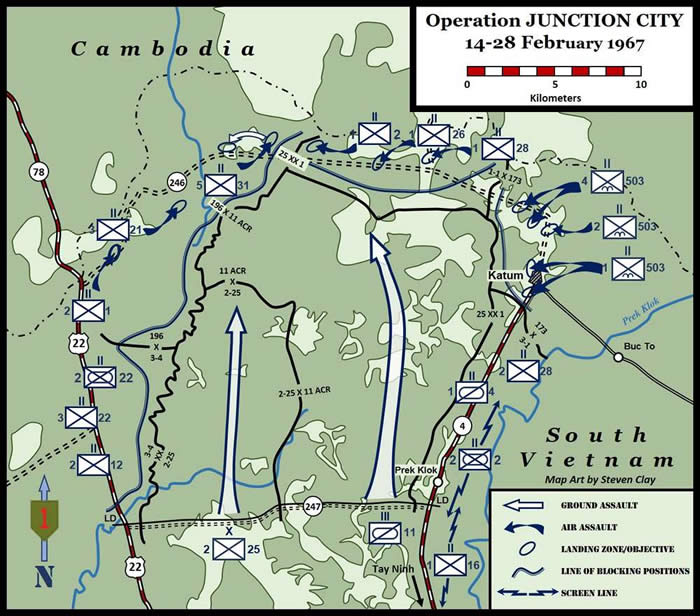
(added - 21 Jan 2023 - Maps courtesy of the 14th Infantry Regiment Association)
VC is an abbreviation Viet Cong - normally composed of South Vietnamese men and women who were 'day time farmers' and 'night time fighters'. While NVA is an abbreviation for a regular unit of the North Vietnamese Army who infiltrated down the Ho Chi Minh trail from North Vietnam into South Vietnam.
The Civil Affairs Activities for Cedar Falls were planned and coordinated by the U.S. 1st Infantry Division's Revolutionary Development Task Force (call sign Helper 6). A total of 5,987 persons were "evacuated" (582 men, 1,651 women, and 3,754 children) - many of whom were the family members of the local VC units. In addition, 247 water buffalo, 225 head of cattle, 158 oxcarts, and 60 tons of rice were moved to ARVN controlled resettlement sites. Some "evacuees" were moved by Chinooks, others by ARVN river boats while other were escorted out on foot. The NVA-VC Headquarters in, around and under the village of Ben Suc along with their underground tunnel complex (>5,000 meters) were destroyed by the 1st Engineer Battalion after the evacuations were complete.
In addition, there were also extended duration provincial clearing operations: Kole-Kole by the 25th Division, Enterprise by the 9th Division, Shenandoah by the 1st Division, Uniontown and Fairfax by the 199th Brigade and Manhattan by the 25th Division. All of these 'cordon and search operations' went on for months at a time with numerous Civic Action projects.
Typical Civil Affairs Platoon Activities during a month (added - 1 Jan 2014 )
The activities of individual platoons varied on a location by location basis and by the local security in an area. In general, the 2nd CA Platoon activities were: (-1-) to assist Refugees (GVN supporters) fleeing their homes during and after battles, to help victims of natural disasters (monsoon and typhoon), to provide Refugees with food, temporary shelter, to help rebuild damaged homes and then to encourage the Refugees that it was safe to return home, to assist with the resettlement of Evacuees (VC families and supporters) after tactical operations, (-2-) to coordinate and to insure that other Allied unit civic action projects conformed to the province's master plan, (-3-) to assist in acquiring and the delivery of construction materials for civic action projects, (-4-) to plan and coordinate MedCAPs (Medical Civic Action Programs), (-5-) to assist with development of local business projects and to improve agricultural production, (-6-) to conduct hamlet surveys and specials studies for MACV-CORDS, (-7-) to advise and assist the GVN with the elimination of corruption within their own administration, (-8-) to encourage and monitor village self-help projects, (-9-) to assist in the erection of village school buildings and to develop educational programs, (-10-) to get Vietnamese to participate in their own self-help civic action programs, (-11-) to promote public information (Psy Ops) to get Evacuees (VC supporters) to support the GVN and (-12-) to do what others, would not do. But the most important personal daily task was to maintain your own 'short time' calendar.
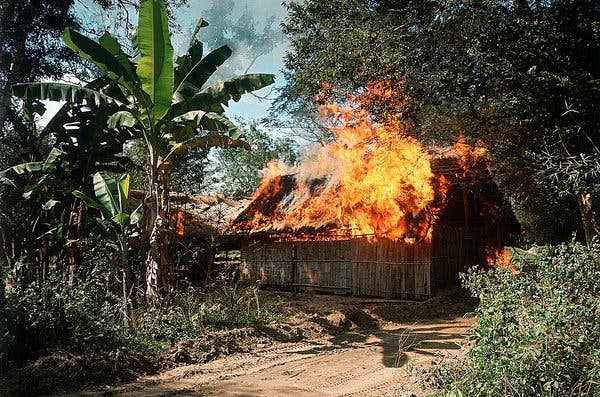
'Zippo Lighter Fire Team' may have unknowning torched a Friendly Hamlet
occupied by the VC-NVA for local Fire Fight.
The Civic Action Project began a few Days After
with a Civil Affairs Platoon gathering of materials and manpower to rebuild a friendly village.
(Location and Date Unknown)
Hamlet Surveys vs. Body Counts (added - 13 Dec 2013 )
Major tactical units often evaluated battlefield success by "body counts" As the war progressed, the accuracy (or inflation) of the "body count" statistics was often questioned even by division and corps commanders. Some enemy units were statistically destroyed three times yet the enemy unit continued to exist. "Body Counts" often effected senior officer promotions !
Beginning in 1967, MAC-V CORDS (Military Assistance Command - Vietnam) (Civil Operations and Rural Development Support) began compiling the Hamlet Evaluation
Survey data (HES) on a monthly and a quarterly basis by rating of the pacification status of the hamlets, villages and districts throughout the Republic of
Vietnam (RVN). Each province, district, village and hamlet in South Vietnam was given a unique HES identification number and based upon "UTM coordinates" because the hamlets and villages often had the same or similar names. With
the cooperation of RVN officials (often less than fully truthful), U.S. District Senior Advisors (DSA) answered multiple choice questionnaire about the military, political, and economic status of each hamlet under their supervision at monthly intervals. In short, the HES was intended to be a cross-section and a time-series data set that measured over 14,000 villages, hamlets and district units on a monthly time basis.
The 2nd CA Platoons often conducted the hamlet surveys and even performed some 'Census Grievance' surveys. Basically, it was hoped a family member would 'rat out' another family member who was a VC supporter and they would ultimately become a candidate for an interview by the Phoenix Team.
The Hamlet Evaluation Surveys were an attempt to measure the relationship between the ARVN's daytime control and nighttime security of an area versus the enemy's nighttime ability to move unreported through an area or to initiate violent acts in any area of South Vietnam. It was hoped that the HES could identify the factors that could predicted US-RVN control of an area during the Vietnam War. Ultimately, NVA T-54 Tanks negated all of the civic action works and HES data when the Republic of Vietnam surrendered and ceased to exist on April 30, 1975.
Analysis of the 2nd CA Monthly Activity Reports by USARV
By the end of September 1967, USARV had completed a study to determine the most effective utilization of the three Civil Affairs companies then 'in-country'. The study even questioned "the need for and the continued existence of the three CA companies" as well as the need for a fourth CA company then being considered but which had been placed 'on hold' pending the results of the study. The final report recommended the orderly and phased transfer of all Civil Affairs platoons and teams "to the field advisors" to be started in and completed by the end of the first quarter of 1968 which was then ordered by USARV.
TET and a change of the mission After TET (revised - 11 Nov 2013 )
The VC-NVA began their TET Offensive during the early morning hours of 31 January 1968 and it soon became a major tactical battlefield defeat for the VC-NVA forces. Most Platoon locations and the Company Headquarters at the Plantation were attacked by VC-NVA infantry assaults
Major battles raged across South Vietnam from the initial assaults thru February 1968 and well into March 1968 when the final tactical victories were achieved over the VC-NVA attackers. Traditional civic actions were delayed while all of the 2nd CA Platoons performed Refugee Assistance missions by providing food and building materials to the Vietnamese people.
The Republic of Vietnam awarded their Civil Action Medal, First Class (pictured above) to the 2nd Civil Affairs Company for their services rendered to the People of Vietnam in the III Corps Tactical Zone - during and after the 1968 TET offensive. Regretfully, the 2nd CA Platoons in the I-CTZ and in the IV CTZ were not specifically mentioned in the citation.
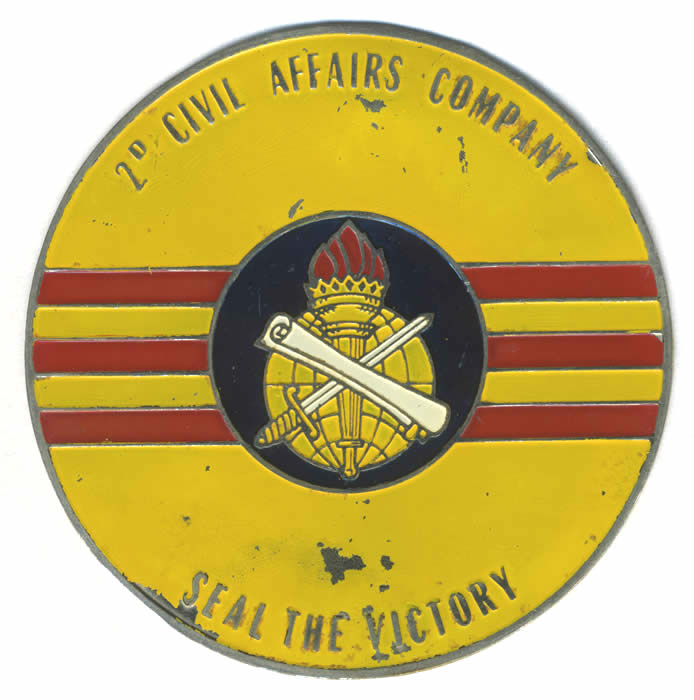
2d Civil Affairs Company - Shirt Pocket Metal Badge (UA) circa 1968
Military Assistance Command, Vietnam (MAC-V) (MACV)
General Order No. 205 from Headquarters, II Field Force Vietnam dated 8 March 1968 confirmed the previous verbal order of the Commanding General, II-FFV effective on 1 March 1968, which "DETACHED" the seventeen "Team AA - Platoons Headquarters" from previous tactical unit attachments in III-CTZ and IV-CTZ as well as the seven CA Teams then attached to selected senior province advisors called "CA Team 31" through "CA Team 37" and reassigned them as "Generalist AA Platoons" to the direct support of provincial revolutionary development projects.
On March 1, 1968, the 2nd Civil Affairs Company was officially reorganized into 19 "Team AA Platoon Headquarters" in Direct Support of selected MACV Province Senior Advisors (PSA) with a reconfigured Company Headquarters (Team AB), a reactivated Civilian Supply Team (BB), a new Civilian Supply & Transport Team (BE), a reestablished Automotive Maintenance Team (DA) as well as the original Public Health Team (NA) which was always authorized but was not always staffed with a U.S. Army Medical Doctor. The authorized MTOE staffing was 48 Officers plus 124 Enlisted Men and the number of authorized vehicles was increased to 59.
When the 2nd CA Platoons were withdrawn from the U.S. and the Allied brigades, the platoons were RENUMBERED and then were ATTACHED to work for the MAC-V's Province Senior Advisors (PSA) and to assist with the implementation of the CORDS Program (Civil Operations and Revolutionary {"Rural" name changed in 1970} Development Support). The Mission of CORDS was: (1) to eliminate the Viet Cong Insurgency (VCI) in South Vietnam {via Project Phoenix with the mission to assist the U.S. State Department's CIA-PRU (Central Intelligence Agency-Provincial Reconniassance Unit) (aka the guys in the Black Uniforms - without Name Tags) to capture and to interrogate or to execute the senior VC leadership} (after 1970, to train the ARVN to execute the missions), (2) to end the Viet Cong's ability to recruit in South Vietnam and (3) to recruit Vietnamese and indigenous tribes to take up arms against the Viet Cong and the North Vietnamese Army (NVA).
MACV had advisory teams with the major ARVN units. There were other MACV advisors who were assigned on an 'area basis' and they were led by the Province Senior Advisor (PSA). The PSAs advised the GVN's provincial governments and there were also small 6-10 man U.S. Army Mobil Advisory Teams (MATs) who advised the local RF-PF (Regional Force - Popular Force) units, the CIDG (Civilian Irregular Defense Group) units and the RD (Revolutionary Development) Cadre. The Popular Force (PF) units were essentially hamlet or town self-defense militias and the Regional Force (RF) units were the district or area response teams. "To Win the Hearts and the Minds", you really need to get the material and other assistance down to the Vietnamese people who live in the small hamlets and villages.
There was at least one 2nd CA Platoon with each province advisory team in the III-CTZ. Some of the more populated provinces had more than one 2nd CA Platoon attached and then one of the 2nd CA platoons usually worked at the PSA Headquarters location while the other 2nd CA Platoon(s) usually worked with one of the PSA's SubSector (District) Teams. Sometimes the 2nd CA Platoons were relocated from one MACV SubSector (District) Team to another within the same province while others stayed at the same location for years. And when the need was determined to be greater elsewhere, the 2nd CA Platoons were moved from one province to another province. In November 1968, three 2nd CA platoons were sent by USARV from the III-CTZ to assist in the I-CTZ.
In March 1968, three platoons (22nd, 21st and ??) were deactivated as part of the reorganization - possibly to provide for the manpower to staff the new or reactivated functional teams. At the same time, all of the remaining platoons were "renumbered". The original 20th Platoon with the 1st Infantry Division at Quan Loi was renumbered as the new 10th Platoon while the original 10th Platoon with the 25th Infantry Division at Dau Tieng was renumbered as the new 18th Platoon. The reason for and the choice of the new numbers for every platoon is not discernable today. The "renumbering" may have been an innovative accomplishment for a member of a G-5 Staff who received an upgraded medal for his creative and his meritorious work. None-the-less, we are still seeking any information about the MACV attachments and the locations of the 11th, 15th and 17th Platoons - before their deployment to the I-CTZ.
On 6 June 1968, the 2nd Civil Affairs Company was officially transferred from II-FFV and reported directly to the United States Army Vietnam (USARV). And a few months later on 28 September 1968, the 2nd CA was transferred from USARV back to the II-FFV. These changes in the 'Chain of Command' had no effect on platoon operations, however, a significant amount of paper work was created for the Administrative Section (S-1) of the 2nd CA's Headquarters Detachment. Your promotions may have been delayed at a higher headquarters but your R&R and DEROS dates were definitely not delayed at Company Headquarters.
In July 1968, the 2nd CA's TO&E was modified by the U.S. Army, Pacific to add one Construction Engineering Officer to each Civil Affairs Platoon.
Three Platoons were sent up north to I-CTZ ( revised 2 Jan 2012 )
In 1968, a higher headquarters determined there was a need for additional Refugee Assistance Teams in the First Corps Tactical Zone (I-CTZ). In late November 1968, our 11th, 15th and 17th Platoons (totaling 6 officers and 12 enlisted men) were sent to Da Nang in I-CTZ to work with the U.S. Marines and with MACV Advisory Teams in the I-CTZ. Some of the Officers and Men accompanied their equipment on a U.S. Navy LST (Landing Ship, Tank) while a few others flew up north to Da Nang. The three platoons reported for duty on 1 December 1968. Their initial deployment may have been contemplated as a short duration 180 day TDY assignment with the 29th Civil Affairs.
The 11th Platoon was sent north to Dong Ha (the first South Vietnamese town just south of the DMZ) in Quang Tri Province which was in the Area of Operations (AO) of the then newly formed XXIV (24th) Corps which assumed Op Con of the 11th Platoon. The 15th and 17th Platoons were sent south to Mo Duc and Nghia Hanh (Nghia Hanh is one of several locations claiming to have been the birthplace of Ho Chi Minh - the leader of North Vietnam) both towns are in Quang Ngai Province - the southern most province in the I-CTZ which was then under the Operation Control of the USMC's Third Amphibious Force (3-MAF).
When the 29th Civil Affairs Company was deployed to Da Nang, VN in 1965, it was officially attached to the U.S. Army's 1st Logistics Command (1st Log) because there were no major U.S. Army ground combat units in the I-CTZ. The 29th CA's Platoons and Teams as well as the 2nd CA's 11th, 15th and 17th Platoons plus four more TDY platoons from the 41st CA were really under the Operational Control (Op Con) of the United States Marine Corps (USMC) Third Marine Amphibious Force (III-MAF or 3 MAF) (the controlling Corps Headquarters for both the USMC 1st and 3rd Divisions as well as for all of the U.S. Army units in the I-CTZ). However, when the extent of the refugee situation was fully assessed, these three platoons were then fully attached on written orders {USARV GO 2086} to the U.S. Army's 1st Logistics Command with a 'thru and to orders' from the U.S. Army Support Command Da Nang and finally to the Op Con of the 29th Civil Affairs Company (29th CA) on 23 May 1969.
During August 1969, the USARV directed the 2nd Civil Affairs Company to create their own in-house training unit - our own Civil Affairs Functional Affairs Specialist Team (CA-FAST) to provide training for all newly assigned company personnel in grades "O-3 and below" because most of the men (80%) assigned to the 2nd CA did not attend the U.S. Army's Civil Affairs School at Fort Gordon, Georgia. The Training Team was to be commanded by a Captain with the assistance of four technical service Lieutenants plus two ARVN NCO Interpreters who conducted courses in: Language and Cultural Affairs, Economic Development (CE), Public Administration (AG), Public Safety (MP) and Food & Agriculture (QM). However, several positions were most often staffed with either Air-Defense Artillery or Armor or Infantry Lieutenants.
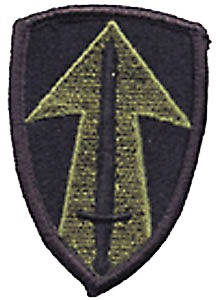
2nd Civil Affairs Company - Shirt Pocket Cloth Patch (UA) circa 1969
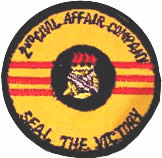
When the supply of the original metal badges was exhausted,
replica cloth patches were made and sold by
the Vietnamese Barber at the Plantation's Barber Shop.
Note the addition of the letter "N" in the 2nd.
In January 1970, the 2nd Civil Affair Company was advised that it would be deactivated on 26 February 1970 as part of a Withdrawal Increment III. Accordingly, on 25 January 1970, five platoons (8th, 9th, 10th, 12th and 13th) stood down, turned in their equipment and the personnel were reassigned to other II-FFV units. However on 3 February 1970, CORDS requested that the CG of II-FFV verbally rescind the stand down orders. The platoons returned to their previous locations and were reattached to the MACV Provincial Advisory Teams. Reacquiring their equipment was difficult.
On 1 March 1970, the 29th CA was transferred from the operational control of the USMC's Third Marine Amphibious Force (III-MAF) and was assigned to the U.S. Army's XXIV (24th) Corps. At almost the same time, the XXIV Corps relocated from Phu Bai to Da Nang.
The plans for the U.S. Withdrawal Increment III included the deactivation of our 11th, 15th and 17th Platoons (as well as eight other CA Platoons that were also in I-CTZ - four from the 41st CA and the once independent 51st, 52nd, 53rd and 54th CA Platoons). After the deactivation, the 2nd CA had only 16 platoons in the field in the III-CTZ and IV-CTZ.
The 2nd CA activated a "new" 11th AA Platoon on 8 April 1970 from "Company assets" and it was attached to MACV Team 48 for Binh Tuy Province at the town of Ham Tan. At various times, the new 11th AA Platoon was tasked to assign at least two "four-man civic action teams" or later four "two-man civic action teams" to work with the MACV SubSector (District) Advisory Teams in three other populated areas within Binh Tuy Province. The Company had increased the number of platoons from 16 to 17.
When two or more 2nd CA Platoons were attached to the same Province Senior Advisor (PSA), normally the 2nd CA Captain worked at the Province Advisory Office and the 2nd CA Lieutenants with the platoon members worked with MACV SubSector (District) Advisor Teams. The combined platoons referred to themselves as the "3/16 AA Platoons" and the "2nd and 14th AA Platoons".
In late April 1970, most of the 2nd CA Platoons were advised that they would soon be withdrawn from their then current MACV Provincial Civic Action assignments and would soon be reattached to the U.S. Army maneuver brigades in anticipation of a future missions and to perform their original mission of "Refugee Assistance" during tactical operations.
Cambodia - May and June 1970 ( revised 2 Jan 2012 )
In mid April 1970, the 2nd CA had 17 platoons in the III-CTZ and IV-CTZ. At least 58 Officers and Men in ten platoons and one provisional team entered into Cambodia (Unit Strength = 139 = 42%) and functioned as 'Refugee Assistance Teams' in support of the tactical operations with the maneuver brigades and battalions from: the 1st Cavalry Division (Airmobile), the 11th Armored Cavalry, the 25th Infantry Division, the 9th Infantry Division's 3rd Brigade (Separate), and the 199th Infantry Brigade. The cross-border activities were called the Cambodian Incursion by the politicians and the Sanctuary Counter-Offensive by the military which were started on 30 April 1970. The 2nd CA Platoons were initially attached to the armored cavalry and mechanized infantry units to provide refugee assistance to the maneuver units as per the Verbal Orders of the Commanding General (VOCG) of II-FFV. The 2nd CA's Commanding Officer requested "written attachment orders" but the attachment orders were never prepared by II-FFV. The CG of II-FFV already "knew" the Sanctuary Counter-Offensive would last for only 60 days (+/-) and thus the 2nd CA's C.O. "did not have a need to know" that time limitations had been imposed upon USARV by the President of the United States. In addition, the U.S. Army Regulations required "written orders" for Temporary Duty (TDY) assignments only when the TDY would last for more than 180 days.
Some of the 2nd CA Platoons were in Cambodia either on Day One or Day Two. And on 5 May 1970, the 2nd CA's Daily Diary recorded the Tiber Team and the 2nd CA's Public Health Team were attached to 2nd Squadron of the 11th Cavalry. They had just entered the Cambodian town of Snoul - 19 miles inside Cambodia. Previously, the town of Snoul had been bypassed to avoid a fight in a populated area but when the NVA fired upon the 11th Cav from the west side of town, an air strike was called in and then there was a brief fire fight in the town of Snoul. The 2nd CA's Public Health Team and Doctor provided medical care to the wounded Cambodian civilians while the Tiber Team buried the dead. The 2nd CA Company Commander provided the money to make the "Solatium Payments" (cash payments made by the U.S. Government via 2CA to Vietnamese and Cambodian Civilians who lost property or family members as a results of accidents of war) to the families of the deceased civilians. Possibly, an example of a 2CA Platoon's activities during the initial phase of the Cambodian Incursion.
The 2nd Civil Affairs Platoons and Teams worked out the Cambodian towns of Memot and Snoul as well as from Fire Support Bases (FSB) Corral, David, Ranch and X-Ray.
On 1 May 1970, the 2nd Civil Affairs Company was issued an additional 20 new 3/4 Ton (M-37) Trucks which were quickly brought forward and put to use in Cambodia. The Company now had a total of 41 of the M-37 Trucks.
While in Cambodia, the 2nd CA Platoons coordinated the repatriation of thousands of Vietnamese and the relocation of local tribes from the Cambodian cross-border areas back to a safe area in RVN, planned the building of resettlement camps in Vietnam, arranged for the movement of and redistribution of 1,100 tons of rice captured from NVA and VC warehouses to the needy, inventoried captured weapons, made solatium payments, arranged for the delivery of building materials to rebuild Cambodian villages destroyed during the battles, conducted numerous MedCAPs and even helped the Cambodian Boy Scouts conduct their weekly meetings.
While eleven of the 2nd CA's seventeen platoons were "in Cambodia", there were four additional platoons stationed in the 'Border Provinces' who greatly assisted with the relocation of refugees in Vietnam and the return of at least 800 Cambodians to Cambodia.
The 6th AA Platoon was attached to the 25th Infantry Division (Rear) and this platoon remained in Tay Ninh Province to coordinate the construction of camps for the estimated 30,000 Vietnamese and local tribes who had become refugees, evacuees or displaced persons. In addition, this platoon coordinated the warehousing and redistribution of food seized in the border areas for use by the camp inhabitants. The 9th AA Platoon resettled refugees in the greater Xuan Loc area and the 7th AA Platoon resettled refugees in the greater Vung Tau area.
After at least 60 days of cross-border operations, all of the U.S. combat brigades along with their attached 2nd Civil Affairs Platoons were withdrawn from Cambodia by 2 July 1970.
Every unit in the U.S. Army was given a campaign participation credit for the Sanctuary Counter-Offensive but very few U.S. Army units actually had 'Boots on the Ground' in Cambodia. The 2nd Civil Affairs Platoons really lived, worked, ate and slept with U.S. Infantry and Cavalry units in Cambodia.
Commander's Evaluation Report - Cambodia Operations ( added - May 2010 )
The Commanding General of II FFORCEV included the following statement in his 31 July 1970 Combat After Action Report:
" 5. The basic objectives of civil affairs support were accomplished with minimum impact on the tactical operation. The contributions of the 2d Civil Affair Company were invaluable, both in assisting the tactical commanders and in supporting the GVN officials."
There was an understanding in the Army that units and the troops normally worked 'one up and two down' in the chain of command. The commander of an army corps (II-FFV) normally would report 'one up' to the chain of command to a higher headquarters (MACV) and normally worked 'two down' from the corps level to a division and / or a brigade size units.
The 31 July 1970 Commander's Evaluation Report does not mention any other battalion or company by name. The only small size unit mentioned in the Civic Action Report by name is the 2d Civil Affairs Company. The General and his staff thought your actions were "invaluable" and a non-traditional acknowledgement was included within the report.
If the 2nd CA was not Valorous, was it not at least Meritorious ? (Aug 2013)
The 1st Cavalry Division (Airmobile) was very properly awarded the VALOROUS UNIT citation [DAGO 1972-43] for their service in Cambodia. The award also included all of the 1st Cav's assigned and attached units which included the entire 11th Cavalry and other independent armored units as well as other infantry battalions from the U.S. 9th and 25th Infantry Divisions and from the 199th Light Infantry Brigade. While it is true that the 2nd CA's sixty days of service in Cambodia with the 1st Cavalry Division (Airmobile) were not direct 'combat action' missions and were, in fact, Refugee Assistance activities.
Narrative - 2nd Civil Affairs Activities ending on 31 July 1970
If the 2nd Civil Affairs' Platoons in Cambodia were not "valorous", then were not the 'invaluable contributions' at least worthy of a mission related Meritorious Unit citation ?
2d Civil Affairs Company - Shirt Pocket Cloth Patch (UA) circa 1970
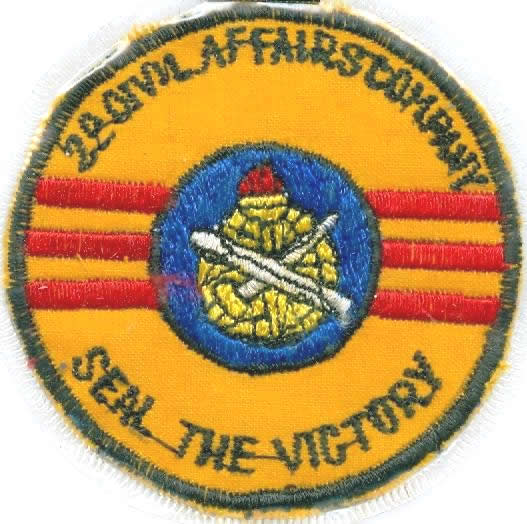
Note the Blue Globe now in the background
and the use of the "2D" again in the unit's name
Back with MACV and the Final Year
After the 1970 Cambodian Incursion, the 2nd CA Platoons were once again attached to worked with the MACV Province and SubSector Advisory Teams.
Only 17 AA Platoons were then in the field and the MTOE strength was reduced to 41 Officers and 100 Enlisted Men. Most of the men were armed with "borrowed" M-16s. And even though the Company had been 'in-country' for more than four years, Radios (AN/PRC 25) (AN/VRC 53) remained in short supply and the all important 2nd CA Radio Net still had not been authorized by II-FFV. The Signal Operating Instructions (SOI) for Radio Frequencies and Call Signs were never established.
The Company now had 59 vehicles. Over the years, the quantity of 3/4 ton trucks (M-37) had been increased from one per platoon to two per platoon. From the original quantity of 13 of the M-37s deployed in 1966, the MTOE for this type of vehicle had been increased to 41 units while the three original and 'once brand new' 2-1/2 tons trucks (M-35) continued to serve faithfully.
After Cambodia, the U.S. had already decided to withdraw maneuver brigades from Vietnam, there were conflicting stand down orders which effected at least two platoons who did stand down. Then a week later, the stand down orders were cancelled and the platoons were reactivated for service again with the MACV Advisory Teams. There were problems reacquiring the men and their equipment.
In early 1971, the Company's Monthly Rosters indicate that the 13th, 14th, 16th and 18th Platoons were deactivated by 1 March 1971 (the new Morning Report Form was DD Form 1 - the strength was 132) and then the 19th Platoon was deactivated by 1 May 1971 (DD Form 1 - the strength was 114). The platoon personnel were reassigned to fill the vacant slots in the other platoons.
On May 2, 1971, Headquarters, Second Field Force - Vietnam (II-FFV) was deactivated and the 2nd Civil Affairs Company was transferred to the operational control of the Third Regional Assistance Command (TRAC) (USARV) until the 2nd Civil Affairs Company was deactivated. (The last available DD Form 1 - stated the May strength was then 60).
The Furling of the Colors
The 2nd Civil Affairs Company was deactivated on July 27, 1971 as part of Withdrawal Increment VIII. The total time "in-country" was 1,711 days. Over the five years of its existence, at least 750 men served in this unit.
|